The SME Content Problem Nobody Talks About

The SME Content Problem Nobody Talks About
Every instructional designer knows the drill. Your subject matter expert schedules a "quick call" to hand off content. Two hours later, you're staring at a 147-slide PowerPoint deck, three Word documents, a folder of screenshots, and a sticky note that says "learners need to know everything."
Welcome to the SME-to-course pipeline — the most time-consuming, least automated part of eLearning development.
Why This Bottleneck Exists
SMEs think in expertise. They know their domain inside-out, which means they struggle to prioritize. Everything feels essential because, to them, it is essential. That 147-slide deck isn't laziness, it's thoroughness without a learning design lens.
The result? IDs spend hours — sometimes days — doing triage work before actual course development even begins:
- Restructuring content into learning objectives
- Separating "need to know" from "nice to know"
- Identifying which content becomes core training vs. job aids
- Rewriting expert-level language for the target audience
- Organizing everything into a logical flow
And then, once you finally have a solid storyboard? You get to spend another day manually building it in your authoring tool. Block by block. Slide by slide.
The Real Cost
Industry estimates put the ratio at roughly 40-80 hours of development per 1 hour of finished eLearning. A significant chunk of that isn't creative work — it's content processing. It's copying text from Word into Rise. It's reformatting bullet points. It's the mechanical assembly that adds zero instructional value.
One instructional designer on Reddit recently shared that their SME's compliance courses had a 23% completion rate and "multiple complaints to HR about death by PowerPoint." Leadership's conclusion? "Learners just don't take compliance seriously." Not "maybe we're doing this wrong."
The tools aren't the problem. Rise is great. Storyline is powerful. The problem is everything that happens between receiving content and opening your authoring tool.
What an Automated Pipeline Looks Like
Imagine this workflow instead:
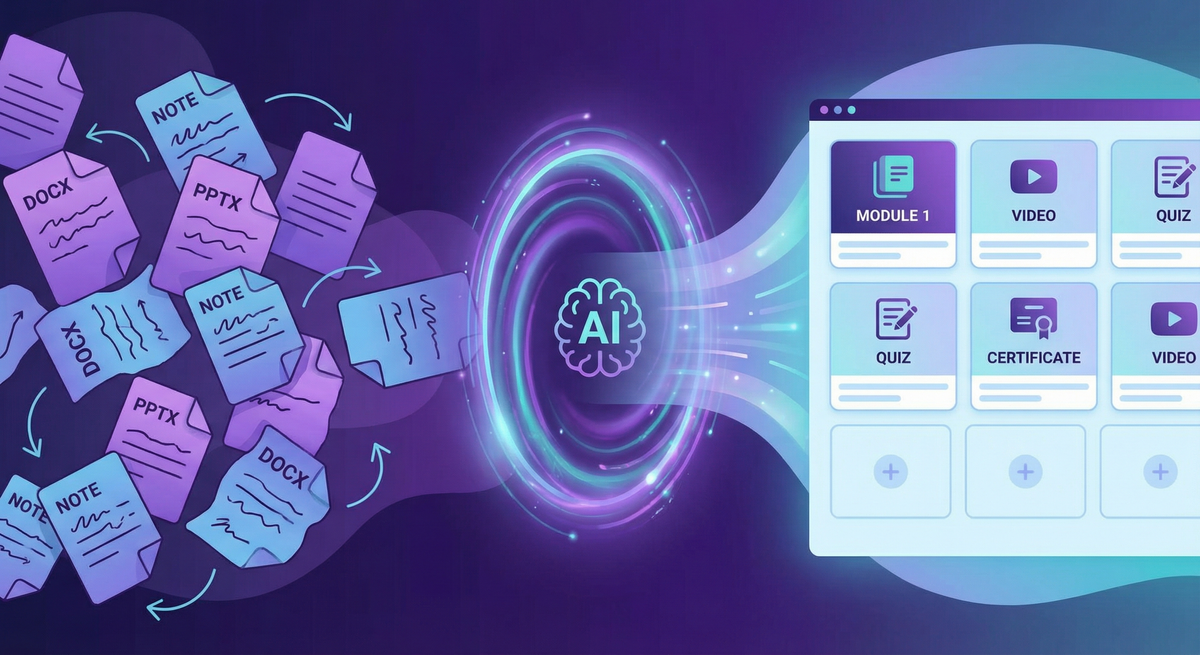
- Upload — Drop in your SME's Word doc, PowerPoint, or PDF
- Triage — AI identifies learning objectives, flags edge cases for job aids, and structures content into lessons
- Review — You approve the structure (5 minutes vs. 5 hours)
- Build — The course assembles automatically in your authoring tool
This isn't science fiction. Parts of this pipeline already exist.
At Happy Alien, we built Storyboard2Rise specifically to eliminate step 4. You write your storyboard in Word, and our Chrome extension builds the Articulate Rise course for you — directly in Rise's interface. No export/import. No SCORM wrapping. It just builds.
We also built a Course Extractor that works in reverse — pulling content OUT of published Captivate courses into Word, PowerPoint, or Markdown. So when you inherit legacy content that needs updating, you don't have to start from scratch.
The Bigger Picture
The eLearning industry is having its AI moment, but most of the attention goes to flashy features — AI-generated avatars, text-to-video, chatbot tutors. Those are interesting, but they're not solving the boring problems that eat up 60% of an ID's week.
The real opportunity is in the plumbing:
- Content triage — AI that can look at raw SME content and suggest structure
- Format conversion — Moving content between tools without manual rebuilding
- Accessibility scanning — Auditing existing courses for WCAG compliance (especially with DOJ deadlines approaching in 2026-2027)
- Bulk updates — Changing branding, policies, or terminology across hundreds of courses at once
None of this is glamorous. All of it saves enormous amounts of time.
What You Can Do Today
While we wait for the full AI-powered pipeline to mature, here are practical steps to speed up your SME-to-course workflow:
- Give SMEs a template. Don't let them freelance the format. A structured Word template with sections for objectives, content, and assessments saves hours of triage.
- Separate review cycles. Get content approved in the storyboard before touching your authoring tool. Rebuilding is expensive.
- Automate assembly where possible. Tools like Storyboard2Rise exist specifically to skip the copy-paste phase.
- Build a job aid library. When SMEs insist "everything is essential," having a ready-made job aid format gives you somewhere to put the edge cases without bloating the course.
- Track your time. Most IDs don't realize how much time goes to mechanical work vs. design work. Tracking it gives you data to justify automation investments.
The SME content bottleneck isn't going away. But with the right tools and processes, you can turn a three-day headache into a three-hour workflow. And spend the rest of your time doing what you're actually good at — designing learning experiences that work.
Happy Alien builds AI-powered tools for eLearning professionals. Check out Storyboard2Rise for automated Rise course assembly, or explore our full toolkit at happyalien.ai.